
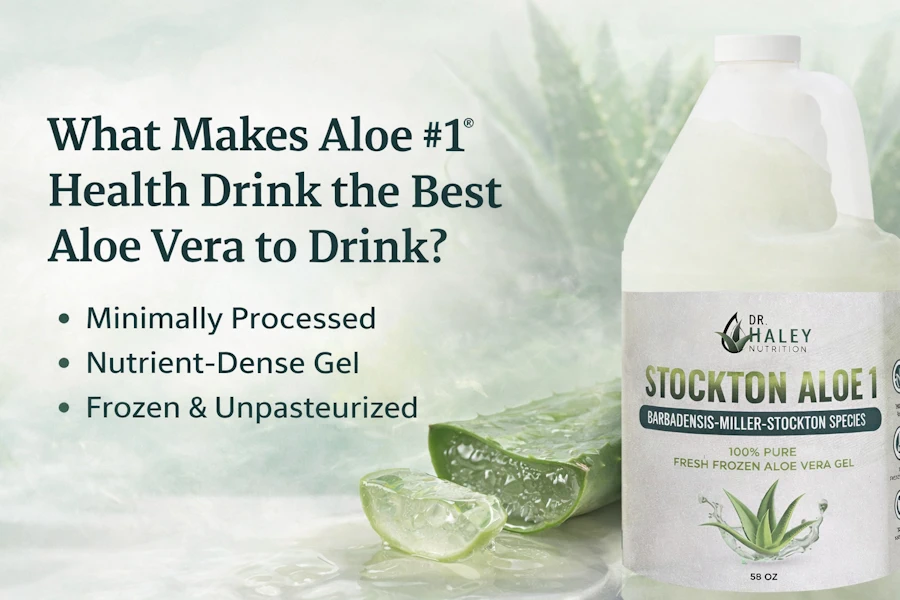
SHORT ANSWER: WHAT MAKES OUR ALOE THE BEST
Aloe #1® is made from mature Aloe barbadensis miller–Stockton plants and processed with minimal handling. The aloe is hand-filleted to naturally limit aloin, slow-ground to preserve the gel, and never pasteurized, diluted, or chemically preserved. Instead of fillers or shelf-stable processing, it is frozen to maintain freshness, natural thickness, and nutritional integrity.
When people ask what makes an aloe vera brand “the best,” the honest answer is that it depends on what you value.
Some people want a product that tastes like fruit punch and sits on a shelf for a year. Others want aloe vera that is as close to the plant as possible, even if that means a thicker texture, a more earthy taste, and frozen shipping.
Stockton Aloe #1® is made for the second group.
Our aloe is minimally processed, nutrient-dense, and handled with the same care you would use if you harvested and prepared aloe yourself. Not everyone prefers that — but for those seeking effectiveness over convenience, the differences are unmistakable.
You may find cheaper aloe products.
You will not find aloe produced with greater attention to plant maturity, handling, and nutrient preservation.
Why Stockton Aloe #1® Feels and Tastes Different
Many people switching to our aloe ask:
“Have I ever actually had real aloe before?”
That reaction happens because most aloe products are heavily filtered, pasteurized, diluted, and preserved. Some are so processed they’re almost indistinguishable from water.
Stockton Aloe #1® is the opposite:
- Naturally thick
- Chunky, pulpy, and viscous
- Similar to freshly scraped aloe gel
That texture is not a flaw — it’s evidence of intact mucopolysaccharides, the very compounds people drink aloe for.
The 10 Factors That Truly Determine Aloe Quality
1. Species and Variety Matter
Not all aloe is safe or beneficial.
While many brands use Aloe barbadensis miller, not all varieties of that species are equal. Aloe pioneer and chemical engineer Rodney Stockton studied aloe plants worldwide and identified one superior medicinal variety, later known as Aloe barbadensis miller-Stockton.
That is the only variety used in Aloe #1® products.
Our plants originate from Rodney Stockton’s own gardens in Fort Lauderdale, Florida.
2. Plant Age Determines Nutrient Density
Aloe vera improves with age.
- Young plants = lower nutrient concentration
- Mature plants (5+ years) = superior gel composition
We only harvest fully mature plants, never immature aloe grown for speed or yield.
3. Proper Pruning Protects the Mother Plant
Aloe “pups” grow around the base of the plant and compete for nutrients.
If they aren’t removed:
- Leaves remain smaller and less mature
- The ratio of outer skin to inner gel increases
- Aloin levels rise, while gel quality drops
At Haley Nutrition:
- Baby plants are removed
- Flowers are removed to conserve nutrients
- Cross-pollination with inferior varieties is prevented
4. Selective Leaf Harvesting
The most nutritious aloe leaves grow at the bottom of the plant.
Best practice:
- Remove three mature leaves at a time
- Allow upper rows to continue maturing
Some companies grind the entire plant at once. That approach yields inferior gel and higher outer-leaf contamination.
We harvest selectively — always.
5. Hand-Filleting (Not Machine Scraping)
The inner gel is where aloe’s benefits come from.
The outer green leaf contains aloin, a bitter anthraquinone with laxative effects.
Many companies:
- Use machines to scrape leaves
- Introduce excess aloin
- Then chemically filter it out
We use a hand-fillet technique:
- Leaves are cut and allowed to “bleed,” draining aloin naturally
- Leaves are rinsed
- Skins are removed by hand — not machine scraped
Because aloin is largely prevented from entering the gel, chemical removal is unnecessary.
Independent testing confirms aloin levels well below the industry standard of 10 ppm.
6. Slow Blending Preserves Structure
High-speed blending:
- Damages delicate components
- Accelerates enzymatic breakdown
- Destroys natural viscosity
We use slow-speed grinding and intentionally leave some gel pieces intact.
This preserves mucopolysaccharides and slows degradation.
We harvest only a two-week supply at a time — so what you receive is typically less than three weeks from the field.
7. Pulp Is Nutrition — Not Waste
Most aloe companies remove pulp to create a “smooth” drink.
That pulp contains:
- Fiber
- Prebiotic compounds
- Nutrients that support gut microflora
We do not remove the pulp.
8. No Pasteurization
Heat damages nutrients.
Most aloe products are:
- Heated
- Preserved
- Hot-filled into plastic drums
- Re-pasteurized during reprocessing
Few brands control the entire process. We do.
Instead of pasteurization:
- Containers are filled and placed into a flash freezer.
- Temperature drops rapidly to prevent fermentation
- Product is quickly frozen
No heat. No hot plastic. No reprocessing.
9. No Fillers or Thickeners

Aloe vera gel is naturally thick.
If a product pours like water, something happened.
Many brands:
- Damage viscosity during processing
- Add gums or thickeners afterward
We retain aloe’s natural viscosity — nothing added.
10. No Chemical Preservatives
Preservatives make food last longer by making it less usable by microorganisms.
That includes:
- Harmful bacteria
- Beneficial gut microbes
When you eat, you are feeding your microbiome.
Preserved foods:
- Alter that ecosystem
- Reduce biological usefulness
Our solution is simple:
- No preservatives
- No shelf stability claims
- Frozen storage to protect nutrients
Why We Do It This Way
At Haley Nutrition, we address all ten quality factors directly — from the field to your freezer.
Yes, it costs more to produce aloe this way.
Yes, it’s harder to ship.
But the result is the aloe vera you buy remains alive, intact, and biologically relevant — not stripped down for convenience.
That’s what Aloe #1® is about.