
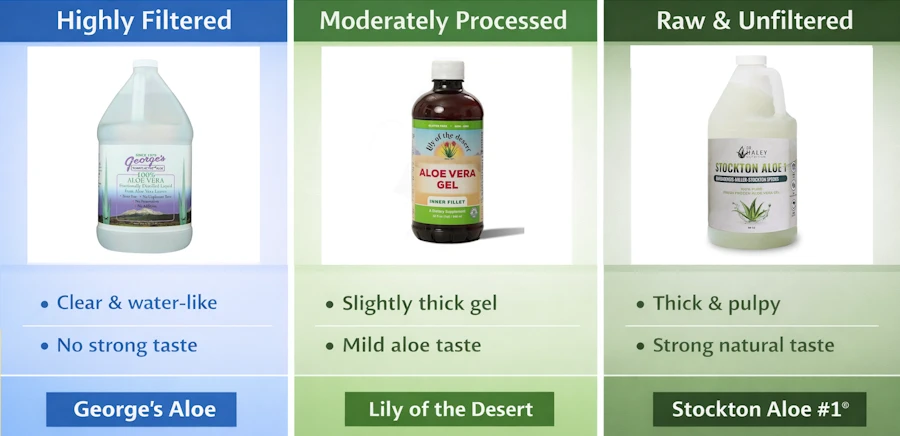
Why Compare Inner Leaf Aloe Vera Drinks?
When it comes to aloe vera, the differences between products can be extreme.
Some are clear and taste like water. Others are thick, pulpy, and closer to the plant itself.
The reason comes down to one key factor:
👉 How much the aloe has been processed
This guide compares three well-known aloe vera products that do NOT have the outer leaf parts intentionally in them. The purpose is to help you understand those differences and choose what’s right for you.
| Aloe Type | Processing Level | Taste | Texture | Appearance | Preservation | Best For |
|---|---|---|---|---|---|---|
| Highly Filtered Aloe | Very high | Neutral (like water) | Very thin | Clear | Shelf-stable | Easy drinking, no taste |
| Moderately Processed Aloe | Moderate | Mild aloe taste | Slightly thick | Translucent | May Have Preservatives added | Balance of convenience and nutrition |
| Raw, Unfiltered Aloe | Minimal | Stronger natural taste | Thick, pulpy | Cloudy / opaque | Frozen | Closest to natural aloe |
1 Minute Video Compares The Two Extremes

🌿 WHY ALOE VERA PRODUCTS ARE SO DIFFERENT
Most people assume inner leaf aloe vera products are similar.
They’re not.
The biggest difference between aloe products is processing, and that affects:
- Taste
- Texture
- Appearance
- Nutrient content
- Shelf life
To make this easier to understand, let’s look at three respected brands that represent very different approaches.
🧪 DETAILED BRAND COMPARISON
| Feature | George’s Aloe | Lily of the Desert (Inner Leaf) | Stockton Aloe #1® |
|---|---|---|---|
| Processing Level | Extremely filtered | Moderately processed | Minimally processed |
| Filtration | Ultra-filtered | Filtered | Unfiltered |
| Appearance | Clear (like water) | Slightly translucent | Cloudy translucent |
| Texture | Very thin | Slightly thick | Thick, pulpy |
| Taste | Neutral | Mild | Stronger natural aloe |
| Mucopolysaccharides | Removed | Partially present | Fully intact |
| Preservation | Shelf-stable | May Have Preservatives | Frozen |
| Pasteurized | Yes (via processing) | Yes | No (raw) |
| Additives | None | May Have Preservatives + thickeners | None |
| Ingredients | 1 | Multiple | 1 |
| Price | Lowest | Mid-range | Highest |
🧠 WHAT THESE DIFFERENCES MEAN
George’s Aloe (Highly Processed)
This product is filtered to the point where it becomes clear and neutral in taste.
It is easy to drink and shelf stable without preservatives.
👉 Best for those who want convenience and no taste
👉 Trade-off: significantly altered from its original form
Lily of the Desert (Moderately Processed)
This option retains more of the plant than highly filtered aloe but still undergoes typical processing.
It may include preservatives and thickening agents to maintain consistency over time.
👉 Best for those seeking balance
👉 Trade-off: not raw, partially modified
Stockton Aloe #1® (Minimally Processed)
This aloe is unfiltered, unpasteurized, and contains no additives.
It is preserved by freezing to maintain its natural structure.
👉 Best for those wanting aloe closest to its natural state.
👉 Trade-off: stronger taste, less convenience, more perishable. Understand shelf life and storage of aloe vera gel.
⚠️ WHAT MOST PEOPLE DON’T REALIZE
Clear aloe may seem “cleaner,” but clarity usually means more processing.
Thicker, cloudier aloe typically means less processing.
That doesn’t automatically make one better—but it does mean they are fundamentally different products.
🧬 WHY THICKNESS MATTERS
The natural thickness of aloe comes from compounds called mucopolysaccharides.
These are long-chain sugars (primarily mannose-based) that:
- Create the gel-like texture
- Break down over time
- Are often reduced during processing
This is why:
- Raw aloe starts thick and becomes thinner over time
- Processed aloe is thin from the start
- Some products use added thickeners
👉 If you’re curious about this, see why aloe can be thick and slimy:
https://haleynutrition.com/why-our-aloe-vera-gel-thick-chunky-and-slimy/
🧩 HOW TO CHOOSE THE RIGHT ALOE VERA PRODUCT
The goal isn’t to find the “best” aloe.
It’s to find what works for you.
| If you want… | Choose… |
|---|---|
| No taste, easy drinking | Highly filtered aloe |
| Balanced convenience | Moderately processed aloe |
| Maximum natural integrity | Raw, unfiltered aloe |
Make the Right Choice for You
The most important step is not which aloe you choose.
It’s that you start using one consistently. Learn more about how much aloe vera you should drink daily.
If you prefer something neutral and easy, there are options.
If you want something closer to the plant in its natural state—with all of its texture and minimal processing—raw aloe may be a better fit.
Why are you hoping to gain from consuming aloe vera? Gut health and immune support are among the top reasons people drink aloe vera gel. Explore aloe vera and gut health benefits.
👉 This may be why taking action is what matters most.
❓ FAQ
Which aloe vera drink is best?
The best aloe vera drink depends on your preference. Some people prefer tasteless, highly processed aloe, while others prefer minimally processed aloe that is closer to the natural plant.
Why is some aloe vera clear and others cloudy?
Clear aloe is typically highly filtered, while cloudy aloe is less processed and contains more of the plant’s natural compounds.
Does thicker aloe mean better quality?
Not necessarily better, but thicker aloe is usually less processed and contains more intact natural components.
Why do some aloe products need refrigeration or freezing?
Less processed aloe may not have preservatives and must be kept cold to maintain freshness and slow breakdown.
Product images used for comparison and identification purposes only. No affiliation or endorsement implied.