
Most of us know that we should eat more fruits and vegetables. Knowing it and consistently doing it, however, are two different things.
Work, travel, food costs, limited preparation time, changing appetites, and personal food preferences can all interfere with our best intentions. The result is that many people repeatedly eat the same few foods and miss the broad variety of plant compounds found throughout the produce aisle.
This is not a minor problem. In a nationwide CDC analysis of 2019 data, only 12.3% of surveyed adults met fruit intake recommendations, and just 10% met vegetable intake recommendations. In other words, approximately nine out of ten adults were falling short in one or both categories.
A powdered fruit and vegetable supplement cannot replace a good diet. It may, however, provide a practical way to add greater plant variety on days when real-life circumstances leave gaps.
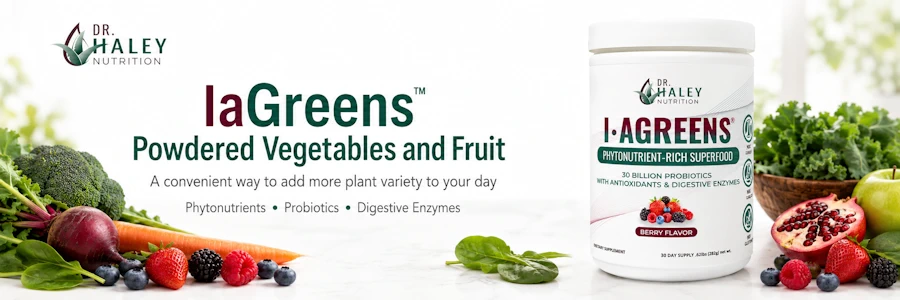
That is where IaGreens® Vegetable and Fruit Powder fits into a sensible nutrition plan.
The Personal Experience That Changed How I Thought About Nutrition
Many years ago, I began supplementing my diet with concentrated powdered fruits and vegetables.
After about a week, the mother of my children approached me with a surprising question:
“Are you taking antidepressants?”
She and her mother had noticed that I seemed happier. I was smiling more, had more energy after work, and was more interested in playing with our children.
No, I was not taking antidepressants.
At the time, I concluded that my diet had not been supplying the plant-based nutrition that served me best. Once I began consuming a much wider variety of concentrated plant ingredients, I personally noticed a significant difference.
That was my experience—not a clinical trial, a diagnosis, or proof that everyone will respond the same way. Nevertheless, it awakened my interest in phytonutrition and began a journey that eventually influenced the development of IaGreens®.
Nutrition Is More Than Protein, Carbohydrates, and Fat
Basic nutrition education commonly begins with the three energy-providing macronutrients:
- Carbohydrates
- Protein
- Fat
Water and dietary fiber are also essential parts of a healthy diet.
We then learn about micronutrients, including vitamins and minerals. Deficiencies of specific essential nutrients can produce recognizable health problems. A severe vitamin C deficiency, for example, causes scurvy, while inadequate vitamin D during childhood can contribute to rickets.
Plants, however, provide much more than their familiar vitamins and minerals.
They also contain an enormous and diverse group of naturally occurring compounds commonly called phytonutrients or phytochemicals.
“Phyto” means plant. Phytonutrients are therefore compounds produced by plants. They contribute to plants’ colors, aromas, flavors, defenses, and other biological characteristics.
Important phytonutrient families include:
- Carotenoids
- Polyphenols and flavonoids
- Glucosinolates
- Organosulfur compounds
- Phytosterols
- Saponins
- Other plant-derived bioactive compounds
Unlike recognized essential vitamins and minerals, most individual phytonutrients do not have an established Recommended Dietary Allowance or Daily Value. Researchers are still investigating how these compounds are absorbed, metabolized, combined, and used within the body.
Vitamins and Phytonutrients Are Not the Same Thing
Vitamins are compounds recognized as essential because the body requires them for normal function and inadequate intake can lead to identifiable deficiency diseases.
Most phytonutrients are not officially classified as essential nutrients. That does not make them unimportant.
Plant compounds are being studied for their relationships to oxidative balance, cellular signaling, enzyme activity, inflammatory pathways, cardiovascular health, vision, cognitive health, and interactions with the gut microbiome. The effects vary by compound, food source, dose, absorption, and the rest of a person’s diet.
This complexity is why it is misleading to think of phytonutrients only as “antioxidants.”
Antioxidant activity is one possible property of some plant compounds. It is not their complete identity, and a high laboratory antioxidant score does not automatically predict a health outcome in a person.
Why “Eat the Rainbow” Is Useful Advice
The colors of plant foods often provide clues about some of the compounds they contain.
For example:
- Dark green foods may supply chlorophyll, lutein, folate, and various polyphenols.
- Orange and yellow foods commonly contain carotenoids such as beta-carotene.
- Red foods may contain lycopene, anthocyanins, or other pigments.
- Blue and purple foods frequently provide anthocyanins and related polyphenols.
- White and tan plant foods can still provide important compounds, including organosulfur substances found in garlic and onions.
Color is not a perfect nutrient calculator. One food can contain many compounds, and similar colors do not make two foods nutritionally identical. Nevertheless, eating plant foods of different colors is an easy, practical reminder to seek variety.
Research reviews suggest that greater fruit and vegetable variety may offer advantages beyond repeatedly eating only one or two familiar choices.
Whole Fruits and Vegetables Should Come First
My first recommendation is still to eat real food.
Whole fruits and vegetables provide combinations of water, fiber, minerals, vitamins, carbohydrates, and plant compounds within their natural food matrix. They also contribute texture, volume, and satisfaction to meals.
Whenever possible:
- Eat vegetables and fruits of several colors.
- Rotate your choices rather than buying the same foods every week.
- Include leafy vegetables, cruciferous vegetables, berries, herbs, roots, and other plant families.
- Choose fresh or frozen produce according to availability and how you plan to use it.
- Grow some food yourself or buy locally when practical.
A greens powder should support these habits—not become an excuse to avoid them.
IaGreens® is specifically presented as a convenient source of additional plant ingredients when whole foods fall short, not as a complete replacement for fruits and vegetables.
What Is IaGreens® Vegetable and Fruit Powder?
IaGreens® is a powdered blend of real fruit, vegetable, green-food, and botanical ingredients. It also contains probiotics and digestive enzymes.
The goal is not to isolate one fashionable “superfood.” It is to provide a broad mixture of plant sources in a form that is easy to use consistently.
Greens and vegetables in IaGreens® include:
Spirulina, barley grass, alfalfa grass, chlorella, kelp, moringa, spinach, kale, broccoli, beet root, carrot, parsley, and cauliflower.
Fruits and other phytonutrient sources include:
Acerola cherry, blueberry, strawberry, raspberry, grape seed and skin extracts, green tea extract, mangosteen, acai, goji, and pomegranate.
Additional herbs and botanicals include:
Turmeric root extract, milk thistle seed extract, licorice root, cinnamon bark, quercetin, and resveratrol from Polygonum cuspidatum.
Digestive enzymes include:
Protease, amylase, lipase, bromelain, papain, cellulase, and lactase.
Probiotic organisms include:
Lactobacillus acidophilus, Bifidobacterium lactis, and Saccharomyces boulardii.
The current formula is free from soy, wheat, gluten, dairy, eggs, preservatives, MSG, shellfish, nuts, artificial colors, and artificial flavors. Readers should always check the current product label because formulations and individual needs can change.
Potential Benefits of Adding a Fruit and Vegetable Powder
The most honest way to describe a greens powder is not as a miracle product, but as a tool.
1. It makes plant variety more convenient
Buying, washing, preparing, and consuming numerous different plant foods every day is difficult for many people.
A single serving of IaGreens® contains ingredients drawn from multiple plant categories. That does not make one scoop equal to eating a plate of intact vegetables, but it does offer more variety than many people would otherwise consume on a rushed day.
2. It can support consistency
The best nutrition plan is not necessarily the most elaborate one. It is the one a person can follow.
IaGreens® can be mixed with water, juice, or a smoothie. Keeping it at home, at work, or with travel supplies makes it easier to maintain a plant-focused routine when fresh produce is inconvenient.
3. It supplies naturally occurring plant compounds
The fruits, vegetables, grasses, algae, herbs, and extracts in the formula contribute an assortment of naturally occurring phytonutrients.
The value is in the diversity of sources rather than an attempt to chase a single laboratory antioxidant number.
4. It includes digestive enzymes
Digestive enzymes help break down components of food. IaGreens® includes enzymes that act on proteins, carbohydrates, fats, lactose, and certain plant materials.
This does not mean the product treats digestive diseases or replaces enzymes prescribed by a healthcare professional. It simply means digestive enzymes are included as one part of the formula.
5. It includes probiotics
IaGreens® contains several probiotic organisms, including bacterial strains and Saccharomyces boulardii.
Probiotic effects are strain- and person-specific. They should not be treated as interchangeable or guaranteed to produce the same result in everyone. Their inclusion gives IaGreens® an additional gut-focused component beyond its plant ingredients.
To understand why the microorganisms living in the digestive tract matter beyond digestion, read How Does Gut Health Affect the Immune System?
Dietary Gaps Are Not the Same as Diagnosed Deficiencies
This distinction is important.
A dietary gap means a person may not consistently consume the amount or variety of foods that would support a well-rounded diet.
A nutrient deficiency means the body has an inadequate supply of a particular essential nutrient. It may be identified through symptoms, health history, examination, or laboratory testing.
IaGreens® can help add plant variety and support a more consistent nutrition routine. It should not be assumed to correct anemia, vitamin B12 deficiency, vitamin D deficiency, or any other specific medical condition.
When a deficiency is suspected or diagnosed, the correct response may include testing, identifying its cause, changing the diet, using a targeted supplement, or receiving medical treatment.
Why We Do Not Promote IaGreens® With an ORAC Target
Years ago, ORAC scores were heavily promoted as a way to compare the antioxidant power of foods and supplements.
ORAC stands for Oxygen Radical Absorbance Capacity. It is a laboratory measurement of how a substance reacts with certain free radicals under test-tube conditions.
That measurement does not tell us how much of a compound will be absorbed, how it will be metabolized, where it will travel in the body, or what measurable effect it will have on human health.
USDA guidance cautions that antioxidant-capacity data from test-tube methods cannot be directly extrapolated to effects in humans. FDA has also stated that “high ORAC” is not an authorized nutrient-content claim because no Daily Value has been established for ORAC.
For that reason, we believe a more responsible discussion focuses on:
- Ingredient quality
- Plant diversity
- Consistent use
- The complete diet
- Realistic expectations
How to Use IaGreens®
Mix one scoop daily with water, juice, or a smoothie, following the current label instructions.
Some people prefer it first thing in the morning. Others take it with a meal or add it to a smoothie. The best time is generally the time that makes daily use easiest to remember.
A simple approach might be:
- Begin with the label serving.
- Mix it thoroughly with your preferred beverage.
- Continue eating whole fruits and vegetables.
- Pay attention to how it fits into your overall routine.
- Store the product according to its label directions.
Because IaGreens® contains numerous botanicals, probiotics, and other active ingredients, people who are pregnant, nursing, immunocompromised, preparing for surgery, managing a medical condition, or taking medications should review the complete label with an appropriate healthcare professional. Dietary supplements can interact with medications and are not substitutes for prescribed treatment.
Who Might Find IaGreens® Helpful?
IaGreens® may be a practical option for:
- Busy people who frequently miss vegetables at meals
- Travelers with limited access to varied fresh produce
- People who tend to eat the same few plant foods repeatedly
- Individuals who want an easy greens powder with probiotics and enzymes
- Families looking for a more consistent plant-focused habit
- People who understand that a supplement supports—but does not replace—a whole-food diet
It is not a cleanse, stimulant, drug, or treatment for disease. It is a convenient food-based supplement designed to help support daily plant intake.
Start With Small, Sustainable Changes
You do not need to change your entire diet overnight.
Add one more vegetable to dinner. Try a fruit or herb you have never eaten. Put berries in the freezer for smoothies. Replace an ultra-processed snack with a whole-food option. Grow something edible, even if it is only a small herb plant near a window or bean sprouts in your kitchen sink.
And on the days when your produce intake does not go according to plan, consider using IaGreens® to help add some of the plant diversity you missed. Many people, like myself, use it every day.
The goal is not dietary perfection.
The goal is to make better nutrition easier, more varied, and more consistent—one meal and one scoop at a time.
Explore IaGreens® Vegetable and Fruit Powder
These statements have not been evaluated by the Food and Drug Administration. This product is not intended to diagnose, treat, cure, or prevent disease.
Sources and Further Reading
- CDC: Adults Meeting Fruit and Vegetable Intake Recommendations — supports the 12.3% fruit and 10% vegetable statistic.
- Clinical Evidence of the Benefits of Phytonutrients in Human Healthcare — supports the broader phytonutrient discussion.
- Phytonutrients: Sources, Bioavailability, Interaction with Gut Microbiota, and Their Impacts on Human Health — supports absorption, metabolism, and gut microbiome statements.
- NIH Office of Dietary Supplements: Dietary Supplements—What You Need to Know — supports the medication-interaction and supplement-safety paragraph.
- FDA warning letter explaining why “High ORAC” is not an authorized nutrient-content claim when no Daily Value exists.
Frequently Asked Questions
What are phytonutrients?
Phytonutrients, also called phytochemicals, are naturally occurring compounds produced by plants. They contribute to characteristics such as color, taste, aroma, and natural defenses. Examples include carotenoids, flavonoids, glucosinolates, and other polyphenols.
Are phytonutrients vitamins?
Most phytonutrients are not classified as essential vitamins and do not have established recommended daily intake levels. They are bioactive plant compounds being studied for their relationships to numerous biological processes.
Is a greens powder as good as eating vegetables?
No. Whole vegetables and fruits provide water, fiber, volume, texture, and a complex natural food matrix. A greens powder is better viewed as a convenient supplement to a varied whole-food diet.
Can IaGreens® correct a vitamin or mineral deficiency?
It should not be assumed to correct a diagnosed deficiency. A deficiency is specific to a nutrient and may require testing and targeted care. IaGreens® is intended to support plant variety and help fill everyday dietary gaps.
Does IaGreens® contain probiotics and digestive enzymes?
Yes. The formula includes several probiotic organisms and enzymes that act on different components of food. Check the current label for the complete ingredient list and amounts.
How often should I take IaGreens®?
The product directions recommend mixing one scoop daily with water, juice, or a smoothie. Follow the current label and ask a qualified healthcare professional when individual medical guidance is needed.
Does IaGreens® replace fruits and vegetables?
No. IaGreens® is designed to supplement a healthy diet when eating enough varied produce is difficult. Whole plant foods should remain the foundation.
About the author: Dr. Michael Haley is a chiropractic physician, health educator, founder of Haley Nutrition, and longtime advocate for whole-food and plant-based nutrition. His personal experience with powdered fruits and vegetables inspired his interest in phytonutrition and the eventual development of IaGreens®.