
Quick Answer
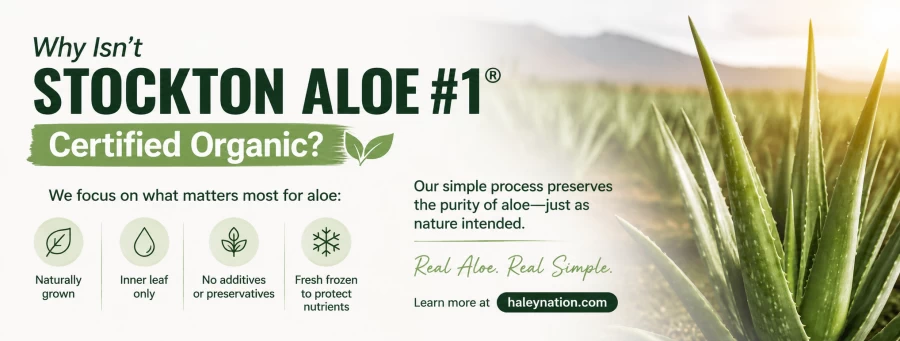
Stockton Aloe #1® is not certified organic because we choose not to pursue certification programs that increase costs without changing our growing or processing practices. Aloe plants naturally resist pests, so pesticides are generally unnecessary, and our process simply involves harvesting leaves, washing them, filleting them, blending the inner gel, bottling it, and freezing it. We do not add preservatives or other ingredients. For aloe products, processing methods and additives may matter more than a certification label.
Many People Assume Organic Means Better
When people ask why our aloe is not certified organic, they are usually asking a larger question:
“How do I know your product is clean and high quality?”
That is a fair question.
Organic certification can be useful because it gives consumers a standardized way to identify products made under certain agricultural and processing rules. But it does not automatically tell you everything about the quality of a product.
With aloe vera in particular, some of the biggest differences between products may have less to do with whether a label says “organic” and more to do with:
- Which part of the plant is used
- How the aloe was processed
- Whether preservatives or additives were added
- How much filtration occurred
- How fresh the product remains
Aloe Naturally Has Few Pest Problems
One reason aloe farming is different from many crops is that aloe plants naturally resist many insects and pests.
From what I have personally seen visiting aloe farms over the years, pesticides generally are not needed. I also have not observed fertilizer use on the aloe farms I have visited.
Our own growing approach uses the weeds themselves in a useful way. Rather than treating them as a problem, we often place them over the aloe plants to provide some shade.
Because of this, many aloe fields may already be operating in ways that would appear very similar to what consumers imagine when they think of “organic farming.”
Where Aloe Products Often Become Different Is During Processing
For aloe products, processing may be where the biggest differences begin.
Our process is simple:
- Harvest the aloe leaves
- Wash them with water
- Fillet the leaves using stainless steel on stainless steel tables
- Blend the inner gel
- Bottle it
- Freeze it
Nothing else is added.
No heat processes.
No preservatives.
No flavoring.
No coloring.
No fillers.
No ingredients intended to extend shelf life.
For Aloe, Processing May Matter More Than Labels
Two bottles can both say “organic” and still be very different products.
For example:
| Question | Why it matters |
|---|---|
| Inner leaf or whole leaf? | Whole leaf products can contain more outer-leaf compounds such as aloe latex |
| Fresh or heavily processed? | Heat and filtration can change the original gel |
| Preservatives added? | Added ingredients change the final product |
| Raw or highly altered? | Processing choices affect the final food |
| Frozen or shelf-stable? | Preservation methods differ |
For aloe specifically, these questions may tell you more than a certification seal by itself.
Does This Mean Organic Certifications Are Bad?
No.
Organic certification can be valuable and important in many situations.
It gives consumers a recognized standard and can provide confidence for many foods and products.
Our decision simply comes down to this:
We are not interested in adding costs that do not meaningfully change what we are already doing.
The same applies to certifications such as:
- Organic
- Kosher
- Non-GMO
For example, as far as we know there is no commercially available GMO aloe vera.
That does not make these certifications unimportant. It simply means we choose to focus our resources elsewhere.
The Question We Think Matters More
Instead of asking:
“Is it certified organic?”
We think a more useful question for aloe products may be:
“What exactly happened to this aloe between the field and the bottle?”
That answer often tells you much more.
Related Questions
- What are the benefits of aloe vera?
- Why does Aloe #1® ship frozen?
- For other questions, visit our FAQ page