
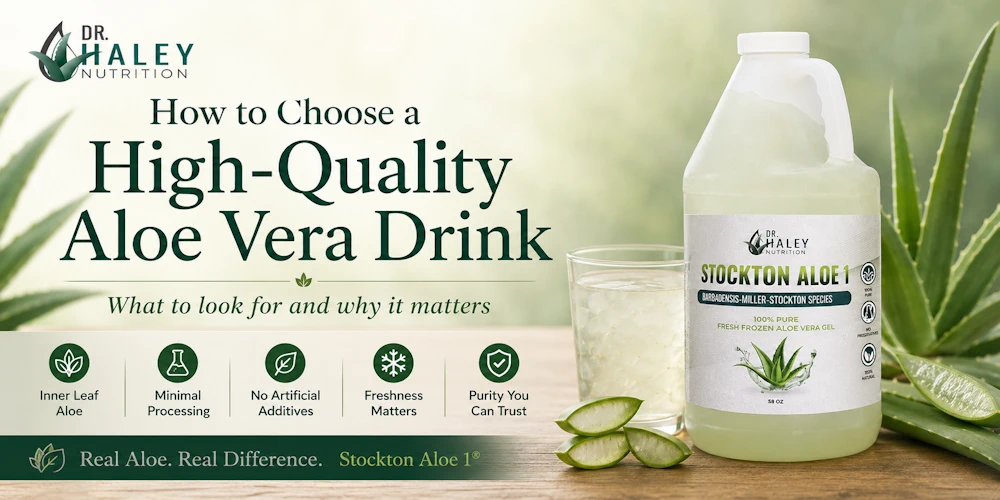
Walk into a health food store or search online for aloe vera drinks and you will quickly discover something confusing: they all look similar, but they can be dramatically different.
Some aloe drinks are made to resemble the natural gel found inside the aloe leaf. Others go through extensive processing that changes the color, texture, aroma, taste, and nutritional profile of the original plant.
So how do you choose a high-quality aloe vera drink?
The answer starts with understanding what aloe vera is, what makes it valuable, and what happens between the farm and the bottle.
If you are comparing products, see our “best aloe vera drink comparison“.
What Makes Aloe Vera Worth Drinking?
Aloe vera has been valued traditionally for centuries as a plant-based food. Modern research has identified many naturally occurring compounds in aloe, including:
- Polysaccharides such as acemannan
- Plant enzymes
- Amino acids
- Electrolyte minerals
- Phytonutrients
- Other naturally occurring plant compounds
Much of the research interest surrounding aloe vera focuses on its polysaccharides, especially acemannan, a compound found in the inner gel of the aloe leaf.
Research suggests aloe vera compounds may help support normal immune function, digestive wellness, and the body’s natural repair processes.
But the quality of the final aloe drink depends heavily on how the plant is handled after harvest.
Learn more about the benefits of aloe vera.
1. Look for Inner Leaf Aloe Vera Gel
One of the first things to understand is the difference between inner leaf aloe vera gel and whole leaf aloe vera.
This is also why understanding aloe vera terms matters.
Inner Leaf Aloe Vera
The inner leaf (also called the inner fillet) is the semitranslucent gel found inside the aloe leaf. This is the part traditionally consumed as a food.
A high-quality inner leaf aloe drink should preserve as much of this natural gel as possible.
Whole Leaf Aloe Vera
Whole leaf products include the outer green rind of the aloe leaf. The liquid in the outer leaf, often referred to as “aloe latex” naturally contains higher levels of anthraquinones, including aloin — compounds responsible for aloe’s well-known laxative effects.
Because of this, many whole leaf aloe products require additional processing steps to reduce these compounds.
This often leads to the next important quality question.
2. Ask How Much Processing Was Used
Aloe vera comes from a living plant. Every processing step has the potential to move it further away from its original form.
Many commercial aloe drinks undergo processes such as:
- Pasteurization
- Fine filtration
- Decolorization
- Deodorization
- Stabilization with preservatives
Some processing may be done for shelf life, consistency, or taste. However, consumers should understand the tradeoff.
What Is Decolorized Aloe Vera?
Decolorization commonly uses activated carbon filtration to remove unwanted compounds, especially from whole leaf aloe products.
While this process can reduce unwanted substances like aloin, it may also reduce other naturally occurring plant compounds.
This is why the starting material matters.
Using carefully prepared inner leaf gel reduces the need for aggressive processing because the outer leaf components were removed before blending.
How to Identify a High-Quality Aloe Vera Drink
| Quality Factor | What to Look For | Why It Matters |
|---|---|---|
| Leaf Part Used | Inner leaf or inner fillet aloe vera gel | The inner leaf contains the semitranslucent gel traditionally consumed as food. |
| Processing | Minimal processing with limited heat treatment, filtering, or decolorization | Less processing helps preserve more of the plant’s natural characteristics. |
| Ingredients | No artificial colors, flavors, preservatives, sweeteners, or thickeners | A short ingredient list usually means the product is closer to the original plant. |
| Texture | Thick, slippery, pulpy, or gel-like consistency | Natural aloe gel contains mucilaginous polysaccharides that contribute to texture. |
| Storage | Refrigerated or frozen if minimally processed | Fresh aloe is delicate and may need cold storage instead of preservatives. |
| Purpose | Aloe gel drink instead of a flavored aloe beverage | Some products are made mainly for taste, while others focus on aloe quality. |
3. Pay Attention to Texture
Many people expect aloe vera drinks to look and feel like water.
But fresh aloe vera gel from the plant is naturally thick and slippery.
That texture comes largely from the mucilaginous polysaccharides found inside the aloe leaf.
Aloe that has been heavily processed, filtered, or diluted may lose much of the texture associated with fresh aloe gel.
A thicker aloe drink is not automatically better — but texture can provide clues about how much the product resembles the original plant.
4. Read the Ingredient Label
One of the easiest ways to judge an aloe drink is to turn the bottle around.
Ask:
“What is actually in this?”
Some aloe drinks contain added:
- Artificial flavors
- Sweeteners
- Colors
- Preservatives
- Stabilizers
- Thickeners
These ingredients may improve taste, texture, appearance, or shelf life — but they also mean the final product is further from the original aloe plant.
A simple ingredient list is often a good sign.
5. Consider Freshness and Storage
Many consumers assume shelf-stable aloe drinks are automatically the best choice because they are convenient.
But shelf stability usually requires some combination of heat processing, preservatives, or other stabilization methods.
Fresh foods are usually more delicate.
Think about other plant foods:
Fresh fruits, vegetables, and juices naturally have shorter lifespans because they are closer to their original state.
Aloe vera is no different.
Choosing a minimally processed aloe drink may require refrigeration or freezing, but those methods can help maintain freshness without relying on unnecessary additives.
6. Choose Aloe for Quality — Not Flavor
Aloe vera gel straight from the plant was never designed to taste like a sweet beverage.
Many aloe drinks are formulated primarily for flavor because that is what sells.
There is nothing wrong with wanting something enjoyable to drink, but consumers should recognize the difference between:
- A flavored-aloe beverage
- A minimally processed aloe vera gel drink
They are not always the same thing.
How Stockton Aloe #1® Is Different
Stockton Aloe #1® Aloe Vera Gel Health Drink is made with a different philosophy:
Preserve the plant as close to nature as possible.
Our aloe is:
- Made from the inner leaf gel only
- Hand harvested
- Hand filleted
- Minimally processed
- Never pasteurized
- Not decolorized
- Not deodorized through activated carbon filtration
- Not diluted with water
- Made without artificial colors, flavors, or preservatives
- Frozen to preserve freshness
The result is a thick, semitranslucent aloe vera gel drink that looks, smells, and feels like aloe directly from the plant.
Stockton Aloe #1® is produced by Haley Nutrition in the Fort Lauderdale, Florida area. Dr. Michael Haley continues the work started by Rodney M. Stockton, who began growing and studying this unique Aloe barbadensis miller variety in 1953.
Frequently Asked Questions About Choosing Aloe Vera Drinks
What is the best type of aloe vera drink?
A high-quality aloe vera drink starts with properly prepared aloe gel and minimal unnecessary processing. Look for inner leaf aloe, simple ingredients, and processing methods designed to preserve the plant’s natural characteristics.
Should aloe vera drinks be clear?
Not necessarily. Aloe vera inner gel is naturally semitranslucent. Products that are extremely clear may have undergone additional filtration or processing.
Is whole leaf aloe better than inner leaf aloe?
They are different. Whole leaf aloe contains the outer leaf and requires additional processing to reduce naturally occurring laxative compounds. Inner leaf aloe focuses on the gel portion traditionally consumed as food.
Why do some aloe drinks contain preservatives?
Preservatives help extend shelf life. Minimally processed aloe products may instead rely on refrigeration or freezing to maintain freshness.
Does aloe vera need to taste good to work?
No. Taste is not a measurement of quality. Some products are designed primarily as beverages, while others focus on preserving aloe in a more natural form.
Experience Aloe Vera Closer to the Plant
Choosing an aloe vera drink is ultimately about deciding what matters most to you.
If you want convenience and flavor, there are many aloe beverages available.
If you are looking for aloe vera gel that is closer to the original plant for drinking aloe vera daily, choose a product focused on purity, freshness, and minimal processing.
Stockton Aloe #1® Aloe Vera Gel Health Drink is made for people who want real aloe — not just a flavored aloe drink.
Learn more or order directly from Haley Nutrition.
REFERENCES:
- Aloe vera: A Short Review
Surjushe A, Vasani R, Saple DG. Indian Journal of Dermatology. 2008.
PMID: 19882025 - Immunomodulatory activity of acemannan
Research on aloe polysaccharides and immune signaling. - Aloe vera gel research review
Reviews discussing aloe constituents including polysaccharides, enzymes, and phenolic compounds.